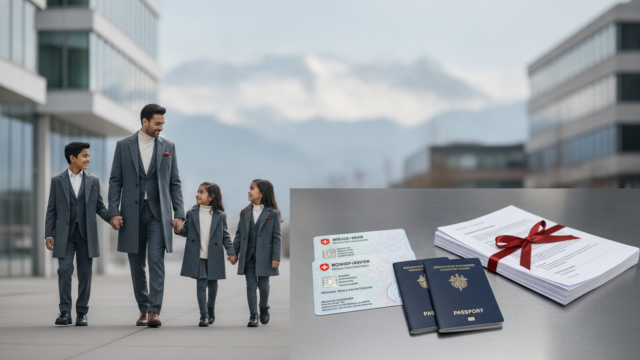

The Swiss Exception in European Context
Switzerland’s naturalization framework remains one of the most demanding in Europe. While many jurisdictions offer citizenship after five years of residence—some even less—the Swiss model operates on a fundamentally different premise. Federal law mandates a 10-year residency threshold, supplemented by a three-tier approval process involving federal, cantonal, and communal authorities. From a strategic perspective, this is not merely an administrative hurdle; it is a long-term integration covenant that treats citizenship as the culmination of a decade of proven economic, social, and legal participation.
> Swiss naturalization is less a bureaucratic formality than a longitudinal assessment of belonging, designed to test sustained integration across multiple governmental layers.
For internationally mobile entrepreneurs and high-net-worth individuals accustomed to expedited global mobility frameworks, the Swiss pathway requires a fundamental recalibration of expectations. The system rewards patience, linguistic investment, and local rootedness over transactional residency.
—
Historical Evolution: From Post-War Modesty to Integration Rigor
The legal architecture of Swiss citizenship has never been static. Its trajectory reflects broader shifts in how the Confederation balances openness with sovereignty.
The 1952 Foundation and Early Limitations
The Swiss Citizenship Act of 1952 established the post-war baseline: a centralized federal framework, but one that delegated substantial discretion to cantons and municipalities. Naturalization volumes remained comparatively low through the 1980s, constrained by restrictive local practices and a foreign-resident population that was itself smaller and less permanent.
Liberalization and Its Discontents (1990s–2000s)
The 1990s marked a turning point. Procedural liberalization—coupled with a growing permanently settled foreign population—triggered a measurable surge in naturalization rates. However, this expansion collided with localized resistance. Most notably, certain municipalities in Appenzell Innerrhoden held popular votes on individual naturalization applications, a practice that permitted majoritarian sentiment to override individual due process.
The Federal Supreme Court intervened in the early 2000s, prohibiting such communal ballots as incompatible with constitutional guarantees. This jurisprudential milestone did not eliminate local discretion, but it channeled it into administrative rather than plebiscitary mechanisms.
The 2018 Reform: Codifying Integration
The 2018 revision of the Swiss Citizenship Act represented the most significant federal tightening in decades. Rather than lowering barriers, the reform codified explicit integration prerequisites—most notably language proficiency benchmarks and clearer economic-self-sufficiency standards. The message was unambiguous: quantitative expansion was no longer the policy objective; qualitative integration was.
| Era | Legislative Character | Naturalization Trend | Defining Feature |
|---|---|---|---|
| 1952–1990 | Restrictive, decentralized | Low volumes | Local veto power |
| 1990–2010 | Procedurally liberalized | Significant increase | Growing permanent foreign population |
| 2010–Present | Integration-focused tightening | Selective, merit-based | 2018 Act codifies B1/A2 language and welfare criteria |
The Architecture of Discretion: Three Levels of Governance
No analysis of Swiss naturalization is complete without addressing its three-level governance structure. Unlike unitary states where a single ministry adjudicates citizenship, Switzerland distributes authority across federal, cantonal, and communal tiers. Each layer adds its own criteria, timelines, and procedural rigor.
Federal Floor
The Confederation sets the non-negotiable baseline:
- 10 years of legal residence (with at least 3 of the last 5 years immediately prior to application)
- B1 spoken and A2 written proficiency in a national language
- Clean criminal record and adherence to public order
- Economic self-sufficiency (generally no reliance on social welfare)
Cantonal and Communal Superstructure
Cantons and municipalities are free to impose stricter requirements. This creates a geographically fragmented landscape that demands careful venue analysis before filing.
- Residency duration: Some cantons require longer local residence than the federal minimum.
- Language standards: Certain jurisdictions demand higher proficiency or test through cantonal-specific oral interviews.
- Integration assessments: Local authorities routinely evaluate an applicant’s familiarity with Swiss customs, neighborhood participation, and institutional knowledge.
| Jurisdictional Level | Core Competency | Typical Additional Requirements |
|---|---|---|
| Federal | Eligibility screening, language minimums, security checks | 10-year residence; B1/A2 language; no welfare dependency |
| Cantonal | Regional integration assessment, extended residency rules | 2–5 years cantonal residence; higher language bars in some cases |
| Communal | Local social insertion evaluation, neighborhood reputation | Local residency duration; communal interview; “social fit” assessment |
—
Integration as a Decade-Long Project
From a legal-advisory standpoint, the 10-year residency requirement is best understood not as a waiting period, but as a longitudinal probation. The 2018 Act transformed integration from an abstract ideal into an auditable matrix of behaviors, competencies, and economic outputs.
Linguistic Capital
The B1 spoken / A2 written standard applies uniformly at the federal level. However, language acquisition is treated as a proxy for social participation, not merely a technical skill. Applicants must demonstrate practical command in professional, administrative, and daily contexts. For international executives and UHNWI clients operating in English-language business environments, this often represents the most underestimated hurdle.
Economic Self-Sufficiency
The requirement to avoid social welfare dependency carries both forward-looking and retrospective dimensions. Authorities examine whether the applicant has relied on means-tested benefits and whether future economic independence is assured. For entrepreneurs and investors, this underscores the importance of stable Swiss tax residency and demonstrable local economic contribution—not merely passive wealth holding.
Legal and Social Record
Even minor repeat offenses can derail an application. Swiss authorities apply a cumulative assessment of an applicant’s respect for public order. Traffic violations, administrative fines, or disputes with neighbors are not automatically disqualifying, but patterns of non-compliance are.
—
Statistical Trajectory and Market Dynamics
The long-term data reveal a policy arc that mirrors Switzerland’s economic and demographic evolution.
Throughout the 1980s, naturalization remained rare. The foreign-resident population was smaller, and local procedural barriers discouraged applicants. The 1990s and early 2000s saw a structural increase in naturalization volumes, driven by:
- A growing permanently settled foreign population
- Procedural streamlining at the federal level
- Generational transitions within resident communities
> The statistical narrative is clear: Switzerland shifted from a model of selective procedural access to one of selective integration merit. Citizenship is no longer primarily a reward for longevity; it is a certification of functional belonging.
For asset managers and family offices advising clients with long-term Swiss residency ambitions, this trajectory implies that early integration investment—language training, local board memberships, philanthropic engagement—generates higher ROI than late-stage file preparation.
—
Facilitated Naturalization and Exceptional Pathways
Not all applicants navigate the standard 10-year track. Swiss law provides facilitated naturalization for specific categories, processed predominantly at the federal level with abbreviated timelines.
Eligible Categories
- Foreign spouses of Swiss nationals (after 3 years of marriage and 5 years of Swiss residence, including 1 year immediately prior to application)
- Third-generation immigrants born and raised in Switzerland
- Children of Swiss citizens born abroad, where a Swiss parent was also born or naturalized in Switzerland
Comparative Matrix
| Criterion | Standard Naturalization | Facilitated Naturalization |
|---|---|---|
| Residency | 10 years (3 of last 5 in CH) | Reduced (varies by category; often 5 years for spouses) |
| Language | B1 spoken / A2 written | Same federal standard, but flexible assessment for some categories |
| Governance | Federal + Cantonal + Communal | Primarily federal; cantonal/communal involvement minimized |
| Processing | Multi-year, multi-layer | Streamlined federal track |
—
Contemporary Debates and Strategic Outlook
Swiss naturalization policy sits at the intersection of economic necessity and cultural preservation. On one side, pro-integration advocates argue that citizenship accelerates labor-market attachment, tax compliance, and social cohesion. On the other, conservative factions view strict naturalization as a democratic safeguard—an institutional filter protecting the substantive values of the Swiss polity.
From a legal-strategic perspective, the trendline favors deepening integration requirements rather than liberalization. The 2018 Act is unlikely to be the final word; cantonal authorities continue to tighten local criteria, and federal jurisprudence increasingly defers to substantive integration assessments over formalistic residency counts.
For demanding clients—whether entrepreneurs establishing Swiss headquarters or UHNWI families building multi-generational presence—the operative advice is to front-load integration. Citizenship should be treated as a 10-year capital project, with annual audits of language proficiency, tax residency integrity, and local social capital.
—
Conclusion: Citizenship as a Mirror of Integration Policy
Swiss naturalization law, viewed across the long arc from 1952 to the present, tells a consistent story. The Confederation does not distribute citizenship as a participation trophy for physical presence. It awards it as the terminal certification of a successful, sustained, and verifiable integration project.
The three-tier governance model, the 10-year residency horizon, and the post-2018 emphasis on language and economic self-sufficiency all point to a single jurisprudential principle: earned belonging over accelerated acquisition. For those with the patience and strategic foresight to treat Swiss citizenship as a decade-long investment, the legal framework is navigable. For those seeking rapid mobility arbitrage, Switzerland remains, by design, the wrong jurisdiction.
> In Switzerland, citizenship is not an entry ticket. It is a diploma awarded after a decade of residency, compliance, and cultural fluency—signed by federal, cantonal, and communal authorities alike.